Over Toilet Aid
An over-toilet aid combines a raised seat with armrests. It must fit over the toilet without contacting the pan, cistern, wall or surrounding fixtures.
Overview
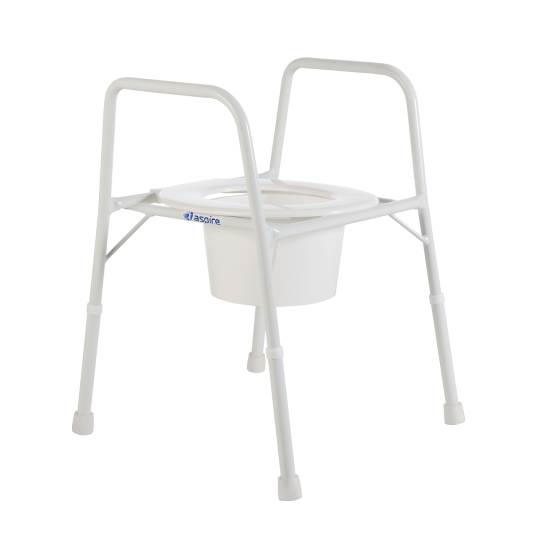
An over-toilet aid is a free-standing frame with:
- Raised toilet seat
- Armrests
- Height-adjustable legs
- Open aperture
- Optional padded seat on some models
Purpose
- Raise toilet-seat height
- Reduce hip and knee flexion
- Assist sit-to-stand
- Provide bilateral arm support
- Offer a removable alternative to permanent modifications
How to Choose
Assess:
- Required final seat height
- Width between arms
- Seat width and depth
- Aperture size
- Toilet-pan width
- Cistern projection
- Toilet-roll holder
- Wall clearance
- Door and shower-screen clearance
- User weight
- Carer space
The Aspire Over Toilet Aid is available in treated steel and aluminium variants with:
- Seat width: 460 mm
- Seat depth: 435 mm
- Seat-to-floor height: 450–630 mm
- Safe working load: 175 kg
Benefits
- Seat and arm height are adjustable
- Bilateral support
- Does not require toilet-bowl mounting
- Easy to remove
- Suitable for changing needs
- Often fits standard toilets better than a fixed raiser
Drawbacks
- Larger footprint
- Legs can obstruct carers
- May not fit around wide or unusual toilet pans
- May interfere with doors or screens
- More surfaces to clean
- Seat may sit forward if the cistern limits placement
- Can rock if legs are uneven
Comparison With Other Toilet Aids
| Aid | Raises seat | Provides arms | Floor-standing | Height adjustment | Main strength | Main drawback |
|---|---|---|---|---|---|---|
| Toilet surround frame | No | Yes | Yes | Arm height adjustable | Stable bilateral support without changing toilet seat | Does not raise seat |
| Over-toilet aid | Yes | Yes | Yes | Seat and arm height adjustable | Combines raised seat and bilateral arms | Larger footprint and may not fit around all toilets |
| Toilet seat raiser | Yes | No | No | Fixed by selected model height | Compact and simple | No arm support |
| Toilet seat raiser with arms | Yes | Yes | No | Usually fixed by selected model height | Compact raised seat with arm support | Must fit toilet geometry and mounting holes |
| Fixed handrail | No | One or both sides depending on installation | No | Fixed after installation | Permanent and does not occupy floor space | Requires suitable wall and correct positioning |
When to Choose an Over-Toilet Aid
Choose when:
- Both raised seat and arms are required
- Toilet-seat raiser compatibility is uncertain
- User needs height adjustment
- Wall rails are unavailable
- Temporary equipment is preferred
- Toilet shape prevents a bolt-on raiser
When to Choose Another Aid
Choose a toilet seat raiser when:
- Space is limited
- Arms are not required
- A compact solution is preferred
Choose a surround when:
- Existing toilet height is suitable
- Only bilateral arm support is required
Choose a fixed rail when:
- Floor space is restricted
- Permanent support is preferred
- Wall structure is suitable
Fitting
- Set all legs to the prescribed height.
- Centre the aperture over the toilet.
- Keep the frame clear of the porcelain.
- Confirm all feet contact the floor.
- Check that the seat does not tilt.
- Confirm the user’s feet remain supported.
How to Use
- Approach using the prescribed mobility aid.
- Turn and back up until the legs touch the seat.
- Reach for both armrests.
- Lower slowly.
- Maintain feet on the floor.
- Push through both armrests to stand.
- Stabilise before moving away.
Risks
- Frame not centred
- Seat too high
- Feet unsupported
- Seat too low
- Legs contacting toilet
- Frame rocking
- User pushing asymmetrically
- Worn rubber tips
- Hygiene aperture poorly aligned
- Exceeding safe working load
Cleaning
- Remove clip-on seat where designed.
- Clean seat, aperture and underside.
- Clean frame and rubber tips.
- Dry all parts.
- Clean after faecal or urinary contamination.
- Do not use chemicals that damage plastic or coatings.
Trial Checklist
- [ ] Final seat height correct
- [ ] Feet supported
- [ ] Width between arms suitable
- [ ] Aperture aligned
- [ ] Frame clears toilet
- [ ] Door and screen clear
- [ ] User can transfer safely
- [ ] Carer access adequate
- [ ] Frame stable
- [ ] Cleaning manageable
Related Notes
References
- Aidacare. Aspire Over Toilet Aid: https://www.aidacare.com.au/products/bathroom-toilet/toileting-aids/over-toilet-aids/aspire-over-toilet-aid/
- Queensland Health. Toilet Seating Equipment guidance.
- Relevant manufacturer instructions and organisational procedures