Shower Chair and Shower Stool
Select the equipment based on the person’s assessed abilities, transfer method, balance, endurance, cognition, body measurements, shower layout and support needs. Check the manufacturer’s instructions and safe working load for the specific product.
Overview
A shower chair or shower stool provides a seated surface for showering.
Both may reduce the effort required to stand during showering and may support safer personal care for a person with reduced balance, strength, endurance or mobility.
A shower chair usually has a backrest and armrests.
A shower stool usually has no backrest. Some models have side handles.
Assistive technology may help a person complete daily activities more safely and independently. The NDIS gives a shower chair as an example of equipment that may reduce falls risk in the shower.
Purpose
- Reduce prolonged standing during showering
- Support balance and stability
- Reduce fatigue, pain or shortness of breath
- Support safer washing of the lower body
- Reduce the physical demands placed on carers
- Maintain independence with personal care
- Reduce falls risk when the equipment is suitable and used correctly
Shower Chair and Shower Stool Comparison
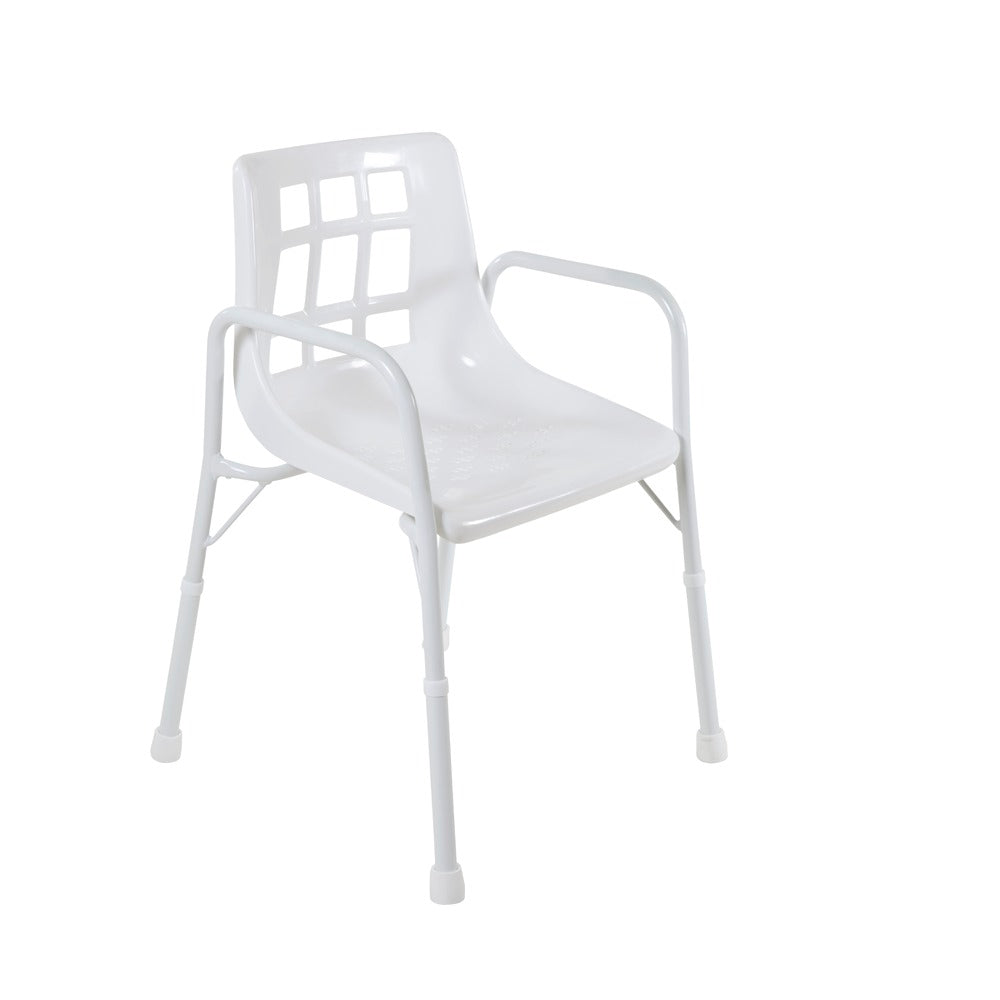
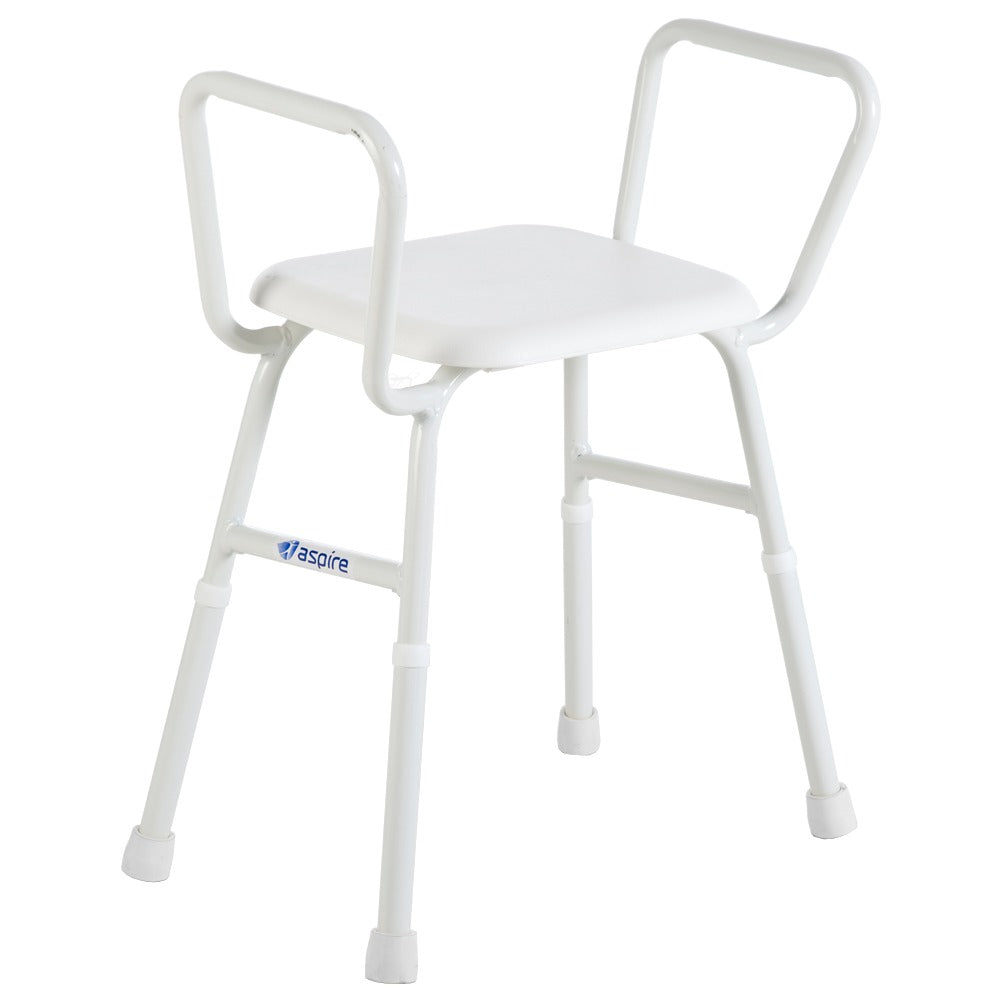
| Feature | Shower chair | Shower stool |
|---|---|---|
| Back support | Included | Usually not included |
| Arm support | Included | Some models have side handles |
| Postural support | Greater | Lower |
| Transfer support | Armrests may assist controlled sitting and standing | Requires more independent balance and transfer control |
| Space required | Usually greater | Usually less |
| Weight | Usually heavier | Usually lighter |
| Portability | May be less portable | Often easier to move and store |
| User effort | May allow more rest | Requires more active trunk control |
| Typical user | Person needing support, rest or transfer assistance | Person with good sitting balance who mainly needs to reduce standing time |
How to Choose Between a Shower Chair and Shower Stool
Choose a Shower Chair When
A shower chair is generally more suitable when the person:
- Has reduced sitting balance
- Becomes fatigued while sitting
- Needs back support to maintain posture
- Has reduced trunk control
- Experiences dizziness, pain or shortness of breath
- Needs armrests to assist with sitting down or standing up
- Requires more time to complete showering
- Needs supervision or physical assistance
- Has reduced confidence in the shower
- Has a history of falls or near misses
- May lean backwards or sideways
- Needs a clearer and more stable seating position
A chair with both backrest and armrests may be preferred when the person requires increased postural support and a more controlled sit-to-stand transfer.
Choose a Shower Stool When
A shower stool may be suitable when the person:
- Has good unsupported sitting balance
- Has adequate trunk control
- Can transfer on and off safely without armrests
- Mainly needs to reduce standing duration
- Requires equipment that fits a small shower
- Needs a lightweight item that can be moved or stored easily
- Can safely reach and wash without losing balance
- Does not require back support during the task
A stool should not be selected only because it is smaller or less expensive. The person must be able to sit, reach and transfer safely without relying on a backrest or armrests.
Choose a Shower Chair Rather Than a Stool When Unsure
A shower chair may provide a larger margin of support when the person’s balance, endurance, cognition or transfer ability is variable.
A trial remains important because armrests, backrests and frame dimensions can also restrict movement or prevent the equipment from fitting the shower.
Decision Guide
| Assessment finding | Usually consider |
|---|---|
| Good sitting balance and independent transfers | Shower stool |
| Reduced endurance but stable unsupported sitting | Shower stool or chair |
| Reduced trunk control | Shower chair |
| Needs arm support for sit-to-stand | Shower chair with armrests |
| Fatigues during showering | Shower chair |
| Small shower enclosure | Compact stool or compact chair after measurement |
| Requires carer assistance | Shower chair, subject to access and manual-handling assessment |
| Variable cognition or safety awareness | Shower chair with supervision and clear instructions |
| Tends to lean backwards or sideways | Shower chair with appropriate postural support |
| Needs frequent repositioning or access for personal care | Trial both options and assess carer access |
| Unable to complete a standing transfer safely | Consider a mobile shower commode or another transfer system rather than a standard chair or stool |
Who May Benefit
A person who has:
- Reduced standing balance
- Lower-limb weakness
- Reduced endurance
- Pain when standing
- Falls or near falls in the bathroom
- Difficulty washing feet or lower legs
- Reduced confidence when showering
- Reduced mobility following illness, injury or surgery
- A need to conserve energy during personal care
- A carer who is assisting with showering
When It May Not Be Suitable
A standard shower chair or stool may not be suitable when the person:
- Cannot maintain a safe seated position
- Requires significant postural support
- Cannot transfer safely using the available method
- Requires hoist transfers
- Exceeds the safe working load
- Has severe involuntary movements
- Attempts to stand without recognising risk
- Has skin or pressure-care needs that are not addressed by the seat
- Requires wheeled transport to and from the shower
- Has a shower base that cannot safely accommodate the equipment
- Has insufficient space for the person, equipment and carer
- Cannot use the item safely because of cognitive, behavioural or perceptual changes
Consider a mobile shower commode, tilt-in-space shower commode, bath board, transfer bench, fixed shower seat or environmental modification when a standard chair or stool does not meet the person’s needs.
Occupational Therapy Assessment
Person
Assess:
- Showering goals and preferences
- Standing and sitting balance
- Trunk control
- Sit-to-stand ability
- Transfer method
- Lower-limb strength
- Upper-limb strength and reach
- Grip and ability to use armrests
- Pain
- Fatigue and exercise tolerance
- Dizziness or postural hypotension
- Falls history
- Skin integrity
- Cognition and safety awareness
- Vision and perception
- Height and weight
- Hip width and thigh length
- Foot placement
- Need for assistance or supervision
Activity
Observe or discuss:
- Entry into the bathroom and shower
- Removal and replacement of clothing
- Transfer onto and off the seat
- Ability to wash all required body areas
- Reaching for taps, soap and shower hose
- Ability to manage the handheld shower
- Drying method
- Duration of the task
- Whether the person attempts to stand during showering
- Carer access and assistance technique
Environment
Assess:
- Shower dimensions
- Door or screen opening width
- Step or hob height
- Floor gradient
- Floor surface and slip risk
- Drain location
- Position of taps and shower hose
- Grab rail location
- Available transfer space
- Carer access
- Toilet, vanity or screen interference
- Whether all equipment feet can remain fully supported
- Storage when the item is not in use
- Ability to keep the bathroom floor clear
Bathroom tiles can become slippery when wet. Purpose-designed grab rails may support safety, while towel rails should not be treated as grab rails.
Measurements
Record measurements before selecting the product.
Person Measurements
- Popliteal height:
- Hip width:
- Thigh length:
- Overall height:
- Weight:
- Preferred sitting height:
- Required armrest height:
Environment Measurements
- Internal shower width:
- Internal shower depth:
- Door or screen opening:
- Shower step or hob height:
- Distance to taps:
- Distance to grab rails:
- Available transfer space:
- Drain position:
- Floor gradient:
Equipment Measurements
- Seat height range:
- Seat width:
- Seat depth:
- Overall width:
- Overall depth:
- Width between armrests:
- Backrest height:
- Safe working load:
- Footprint at prescribed height:
[!tip]
Measure the overall footprint, not only the seat width. Height-adjustable legs may spread outward and increase the space required.
Features to Consider
Backrest
A backrest may assist when the person:
- Has reduced trunk endurance
- Needs rest during showering
- Has reduced balance
- Requires a clear seating boundary
- Tends to lean backwards
Check that the backrest does not interfere with the shower controls, wall, hose or the person’s washing method.
Armrests
Armrests may:
- Assist controlled sitting and standing
- Provide lateral boundaries
- Increase confidence
- Reduce usable seat width
- Restrict side transfers
- Limit carer access
Confirm that the person can grip and load the armrests safely.
Seat Height
The height should usually allow:
- Feet to rest securely on the floor
- Hips to be level with or slightly higher than knees when appropriate
- A controlled sit-to-stand transfer
- Clearance from the shower screen or fixtures
- Stable contact of all equipment feet with the floor
A seat that is too low may increase the effort required to stand.
A seat that is too high may reduce foot contact and sitting stability.
Seat Size
Check:
- Hip clearance
- Thigh support
- Pressure distribution
- Access for washing
- Space between armrests
- Whether the seat depth restricts knee movement
- Whether the seat is too narrow or too large for stable sitting
Seat Surface
Consider:
- Drainage holes
- Slip-resistant texture
- Comfort
- Cleaning
- Skin integrity
- Pressure risk
- Whether textured surfaces create discomfort
Legs and Feet
Choose:
- Height-adjustable legs where required
- Non-slip ferrules suitable for wet areas
- Legs that lock securely
- A frame that remains stable on the shower floor
Do not use the equipment when ferrules are worn, missing, loose or contaminated with soap residue.
Materials
Select corrosion-resistant materials intended for wet-area use.
Check for:
- Rust
- Cracks
- Loose fasteners
- Sharp edges
- Water trapped inside components
- Deteriorated plastic or rubber parts
Safe Working Load
The person’s weight must remain within the manufacturer’s stated safe working load.
Do not assume that all shower chairs and stools have the same capacity.
Equipment Trial
Trial the proposed equipment in the actual shower where possible.
Assess:
- Entry into the shower
- Positioning of the equipment
- Transfer onto the seat
- Sitting stability
- Foot placement
- Ability to reach taps and shower hose
- Ability to wash safely
- Need to stand
- Transfer off the seat
- Ability to exit the shower
- Carer position
- Equipment movement
- Water drainage
- Client comfort and preference
Do not proceed when the equipment rocks, slides, bridges the drain, sits partly on a raised edge or prevents safe access.
Set-Up Instructions
- Place the chair or stool fully inside the shower.
- Position all feet on a stable part of the shower floor.
- Keep feet away from raised edges and unstable drain covers.
- Adjust all legs to the prescribed height.
- Confirm each adjustment pin or clip is fully engaged.
- Check that the seat is level unless the manufacturer specifies otherwise.
- Check that all ferrules contact the floor.
- Position the item so the person can reach the shower controls and hose.
- Maintain space for safe transfer and carer assistance.
- Complete a stability check before use.
How to Use
Before Use
- Check the frame, seat, legs, ferrules and fasteners.
- Confirm the equipment is stable.
- Remove soap, shampoo and water from the transfer path.
- Place toiletries within safe reach.
- Use a handheld shower hose when prescribed.
- Arrange supervision or assistance when required.
- Ensure adequate lighting.
- Check water temperature before showering.
Sitting Down
- Approach using the prescribed mobility aid.
- Turn using the recommended transfer method.
- Move backwards until both legs touch the seat.
- Reach for the armrests when available and safe to use.
- Lower slowly onto the centre of the seat.
- Place both feet securely on the floor.
- Adjust posture before beginning showering.
During Showering
- Remain seated when this is the prescribed method.
- Keep both feet supported.
- Avoid leaning beyond the base of support.
- Bring toiletries within reach rather than stretching.
- Use installed grab rails only as prescribed.
- Request assistance for areas that cannot be reached safely.
- Avoid using the chair or stool to support forceful pulling or pushing unless designed for this purpose.
Standing Up
- Move forward on the seat as instructed.
- Place both feet in the recommended position.
- Use armrests or a prescribed grab rail when appropriate.
- Lean forward using the practised method.
- Stand in a controlled manner.
- Stabilise before stepping away.
- Use the prescribed mobility aid.
After Use
- Rinse soap residue from the equipment.
- Allow it to dry.
- Store it without blocking access.
- Report movement, damage, pain, falls or near misses.
Safety Issues
Main Risks
- Slipping during transfer
- Equipment movement
- Incorrect seat height
- Insufficient foot contact
- Overreaching
- Loss of balance while washing
- Legs positioned partly on a shower edge
- Worn or missing ferrules
- Exceeding the safe working load
- Incorrect assembly
- Corrosion or structural failure
- Skin injury
- Hot water exposure
- Carer manual-handling injury
- Using towel rails or unstable fixtures for support
- Standing on the seat
Risk Controls
- Complete an individual assessment and trial
- Measure the person and shower
- Select the correct size and safe working load
- Adjust all legs evenly and lock them
- Position all feet on a stable surface
- Keep the transfer path dry and clear
- Provide grab rails or other supports when clinically indicated
- Position toiletries within reach
- Train the person and carers
- Inspect the equipment regularly
- Review after falls, near misses or functional change
Do Not
- Stand on the shower chair or stool
- Use it as a step
- Pull it towards the body during a transfer
- Use towel rails for body-weight support
- Use the equipment with missing ferrules
- Use it when unstable, damaged or corroded
- Place it partly on a shower hob or raised drain
- Exceed the safe working load
- Make unapproved modifications
- Use a wheeled shower chair without applying brakes as instructed
Carer and Support Worker Instructions
- Follow the assessed transfer method.
- Avoid lifting the person manually unless this is part of an assessed procedure.
- Maintain enough space to assist without twisting or overreaching.
- Keep the person within a stable sitting position.
- Do not allow the person to pull on the carer during transfers.
- Report changes in balance, strength, cognition or transfer ability.
- Report all falls, near misses and equipment faults.
- Request review when the current equipment no longer supports safe care.
Cleaning and Infection Control
- Rinse after use.
- Clean using products approved by the manufacturer.
- Remove soap and body-product residue.
- Pay attention to drainage holes, joints and ferrules.
- Dry the equipment where possible.
- Do not use products that damage plastic, rubber or metal surfaces.
- Follow organisational infection-control procedures for shared equipment.
Maintenance
Check regularly for:
- Loose screws or fasteners
- Cracks in the seat
- Bent frame components
- Rust or corrosion
- Worn or missing ferrules
- Stiff or damaged adjustment mechanisms
- Unstable legs
- Faded safe working load labels
- Mould or trapped moisture
Replace damaged components using manufacturer-approved parts.
Inspection Checklist
- [ ] Equipment is the prescribed item
- [ ] Safe working load is suitable
- [ ] Seat height remains correct
- [ ] All adjustment pins are engaged
- [ ] Frame is stable
- [ ] Seat is secure
- [ ] Backrest is secure when included
- [ ] Armrests are secure when included
- [ ] Ferrules are present and in good condition
- [ ] No rust, cracks or sharp edges
- [ ] Equipment fits fully within the shower
- [ ] Transfer space is clear
- [ ] Toiletries and shower hose are within safe reach
- [ ] Client can use the equipment safely
Troubleshooting
| Problem | Possible cause | Action |
|---|---|---|
| Equipment rocks | Uneven leg adjustment, sloping floor or damaged frame | Reposition and check adjustments. Stop use if instability remains |
| Equipment slides | Worn ferrules, soap residue or unsuitable floor | Clean the floor and ferrules. Replace worn parts |
| Feet do not reach the floor | Seat is too high | Reassess and adjust height |
| Difficulty standing | Seat is too low, reduced strength or poor foot position | Reassess height and transfer method |
| Armrests restrict transfer | Incorrect style or width | Trial a different configuration |
| Backrest limits shower access | Incorrect position or product design | Reposition or trial an alternative |
| Person leans or slips | Reduced balance, unsuitable seat or incorrect height | Stop use and request reassessment |
| Chair does not fit | Overall footprint is too large | Trial a compact model or another showering solution |
Review Triggers
Review the equipment when there is:
- A fall or near miss
- A change in mobility
- A change in transfer ability
- Increased fatigue or pain
- Reduced sitting balance
- Cognitive or behavioural change
- Weight change
- Skin damage
- Increased carer assistance
- A bathroom modification
- New mobility equipment
- Repeated equipment movement
- Damage or corrosion
Client Instruction Summary
What It Is For
The shower chair or stool provides a seated position during showering. It may reduce fatigue and support balance.
Before Using It
- Check that it is stable.
- Check that all feet are on the floor.
- Keep the floor clear.
- Place toiletries within reach.
- Arrange help when required.
How to Use It
- Move backwards until your legs touch the seat.
- Use the armrests or prescribed grab rail.
- Sit down slowly.
- Keep both feet supported.
- Avoid leaning or reaching too far.
- Stand using the practised method.
Stop Using It When
- It moves or rocks
- A ferrule is missing
- The frame or seat is damaged
- You feel unsafe
- You have a fall or near miss
- Your ability to transfer has changed
Related Assistive Technology
- Handheld Shower Hose
- Grab Rails
- Bath Board
- Transfer Bench
- Mobile Shower Commode
- Long-Handled Sponge
- Non-Slip Bathroom Flooring
References
- Australian Government Department of Health, Disability and Ageing. Support at Home services and Assistive Technology and Home Modifications scheme.
- National Disability Insurance Agency. What is assistive technology.
- Better Health Channel. Preventing falls at home.
- Better Health Channel. Dementia and hygiene.
- Relevant manufacturer instructions for use.
- Relevant organisational policies and Australian Standards.