Toilet Seat Raiser
A toilet seat raiser must fit the exact toilet bowl and mounting arrangement. “Fits most toilets” does not mean it fits every toilet. Trial for security, hygiene access and transfer height.
Overview
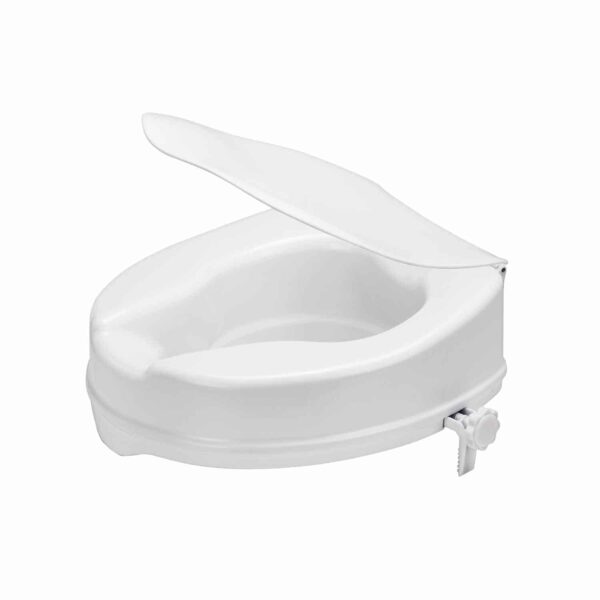
A toilet seat raiser increases the height of the existing toilet.
Types include:
- Fixed-height clip-on raiser
- Fixed-height bolt-on raiser
- Adjustable-height raiser
- Angled raiser
- Raiser with or without lid
Fixed Height vs Adjustable Height
| Feature | Fixed height | Adjustable height |
|---|---|---|
| Setup | Select one height | Can be changed within a range |
| Stability | Often simple and rigid | Depends on adjustment mechanism |
| Cleaning | Usually simpler | More joints and components |
| Best suited to | Stable long-term needs | Changing needs or trial |
| Main risk | Wrong selected height | Incorrect or uneven adjustment |
How to Choose Height
Common fixed rises include:
- 50 mm
- 60 mm
- 100 mm
- 150 mm
The correct final height should allow:
- Feet on floor
- Controlled sitting
- Safe standing
- Appropriate hip and knee angle
- No perching
- Adequate clearance for personal hygiene
Too high:
- Feet unsupported
- Sliding
- Difficult bowel emptying
- Unsafe dismount
Too low:
- Transfer remains difficult
- Excessive hip and knee flexion
- Increased carer assistance
Product Comparison
| Product | Height options | Mounting | Safe working load | Main feature |
|---|---|---|---|---|
| Aspire Toilet Seat Raiser | 50, 100 or 150 mm | Adjustable mounting brackets | 200 kg | Three fixed-height choices |
| Etac Hi-Loo Fixed | 60 or 100 mm | Fixed mounting through toilet-seat bolt area | 150 kg | Ergonomic opening, detachable for cleaning |
| Adjustable-height raiser | Product dependent | Bowl, bolt or frame mounting | Product dependent | Height can be changed after installation |
The Etac Hi-Loo also has an angled version intended for restricted knee or hip mobility.
Toilet Compatibility
Check:
- Bowl shape
- Bowl length
- Bowl width
- Flat contact surface
- Mounting-hole spacing
- Hinge position
- Cistern clearance
- Bidet hose
- Raised rear porcelain
- Toilet lid
- Splash guard
- Side profile
Splash Guard and Unusual Toilet Shapes
Some toilets have:
- High splash guards
- Raised rear rims
- Integrated bidet features
- Square pans
- Elongated pans
- Short pans
- Concealed-fixing seats
These may prevent the raiser from:
- Sitting flat
- Clamping securely
- Aligning with the aperture
- Allowing the lid to close
- Remaining stable during side loading
Do not force a raiser onto an incompatible toilet.
Benefits
- Compact
- Does not occupy floor space
- Reduces transfer effort
- Often easy to remove
- Lower cost than a full over-toilet aid
- Preserves bathroom circulation
Drawbacks
- No arm support
- Compatibility problems
- Can loosen
- Can trap urine or faeces
- May shift under side loading
- Fixed models cannot adapt after supply
- Very high models may affect bowel function and foot support
Comparison With Other Toilet Aids
| Aid | Raises seat | Provides arms | Floor-standing | Height adjustment | Main strength | Main drawback |
|---|---|---|---|---|---|---|
| Toilet surround frame | No | Yes | Yes | Arm height adjustable | Stable bilateral support without changing toilet seat | Does not raise seat |
| Over-toilet aid | Yes | Yes | Yes | Seat and arm height adjustable | Combines raised seat and bilateral arms | Larger footprint and may not fit around all toilets |
| Toilet seat raiser | Yes | No | No | Fixed by selected model height | Compact and simple | No arm support |
| Toilet seat raiser with arms | Yes | Yes | No | Usually fixed by selected model height | Compact raised seat with arm support | Must fit toilet geometry and mounting holes |
| Fixed handrail | No | One or both sides depending on installation | No | Fixed after installation | Permanent and does not occupy floor space | Requires suitable wall and correct positioning |
Installation
- Follow manufacturer instructions.
- Remove the existing seat if required.
- Align brackets or bolts.
- Tighten evenly.
- Confirm full contact with the bowl.
- Check front, rear and side movement.
- Recheck after initial use.
How to Use
- Confirm the raiser is secure.
- Approach and turn using the prescribed method.
- Reach for a separate rail if prescribed.
- Lower in a controlled manner.
- Keep feet supported.
- Stand using the prescribed support.
Cleaning
- Remove the raiser where designed.
- Clean the top, underside and brackets.
- Clean the toilet contact surface.
- Use manufacturer-approved detergent.
- Dry before refitting.
- Inspect for staining, cracking or movement.
Etac states the Hi-Loo can be cleaned with a solvent-free pH 5–9 agent or 70% disinfectant solution, and selected cleaning in a washer-disinfector is permitted under its instructions.
Risks
- Poor fit
- Loose brackets
- Raiser movement
- Excessive height
- Feet unsupported
- Cracking
- Hygiene buildup
- Side-transfer loading
- Splash guard interference
- Mounting holes outside adjustment range
- User relying on the raiser as an arm support
Trial Checklist
- [ ] Correct height
- [ ] Feet supported
- [ ] Bowl shape compatible
- [ ] Mounting holes compatible
- [ ] Splash guard clear
- [ ] Raiser sits flat
- [ ] No side movement
- [ ] Hygiene access adequate
- [ ] User can sit and stand safely
- [ ] Cleaning can be completed
Related Notes
- Toilet Seat Raiser with Arms
- Over Toilet Aid
- Toilet Surround Frame
- Handrails and Grab Rails
References
- Etac. Hi-Loo Fixed: https://www.etac.com/products/bathroom-aids/raised-toilet-seats/etac-hi-loo-fixed/
- Aidacare. Aspire Toilet Seat Raiser: https://shop.aidacare.com.au/products/aspire-toilet-seat-raiser
- Relevant compatibility guides, manufacturer instructions and organisational procedures