Toilet Surround Frame
A toilet surround frame provides bilateral arm support but does not raise the toilet seat. Select it after assessing toilet height, transfer method, armrest height, frame width, floor space and toilet clearance.
Overview
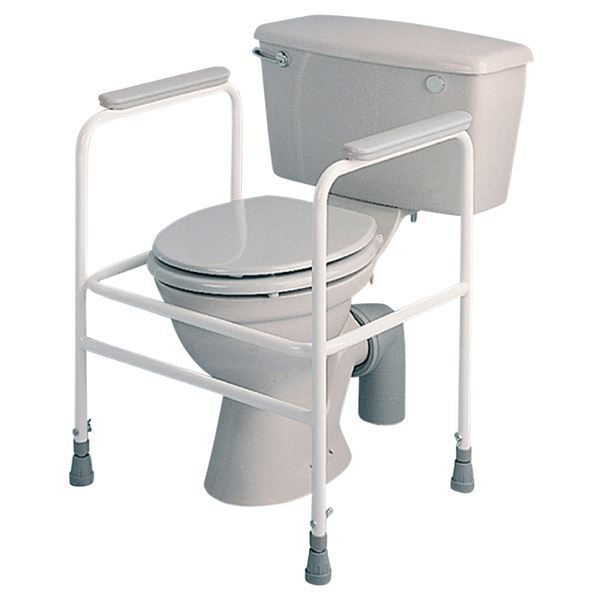
A toilet surround frame is a free-standing frame placed around the toilet.
It usually includes:
- Two armrests
- Four height-adjustable legs
- Rubber feet
- Open access to the existing toilet seat
Purpose
- Provide bilateral support during sit-to-stand
- Support controlled lowering
- Reduce reliance on towel rails or unstable fixtures
- Provide a removable option where wall rails cannot be installed
- Maintain use of the existing toilet seat
Why Choose a Toilet Surround Instead of a Handrail?
Choose a toilet surround when:
- Bilateral arm support is required
- The wall is too far from the toilet
- Wall structure is unsuitable for a grab rail
- The home is rented
- A temporary option is needed
- The user benefits from armrests positioned like a chair
- The transfer method may change
Choose a fixed handrail when:
- One-sided support is sufficient
- Floor space is limited
- A permanent solution is preferred
- The wall can support a properly installed rail
- The user needs continuous support extending beyond the toilet
- The frame would obstruct carers or mobility aids
Toilet Surround vs Handrail
| Consideration | Toilet surround | Fixed handrail |
|---|---|---|
| Support | Bilateral | Usually one side unless two rails installed |
| Height | Adjustable | Fixed after installation |
| Floor space | Requires space around toilet | Does not occupy floor space |
| Portability | Removable | Permanent |
| Wall requirement | None | Requires suitable wall structure |
| Transfer feel | Similar to chair armrests | Depends on rail orientation and position |
| Cleaning | Frame and floor around legs | Rail and wall |
| Main risk | Frame movement or leg obstruction | Incorrect position or structural failure |
How to Choose
Assess:
- Toilet seat height
- User hip width
- Width between arms
- Armrest height
- Toilet width and cistern
- Floor space
- Door swing
- Shower screen
- Vanity
- Walking-aid access
- Carer position
- Safe working load
Fitting
Set the armrests so that:
- Shoulders remain relaxed
- Elbows are slightly flexed
- User can push down through both arms
- Hands remain on the armrests throughout the transfer
- Feet remain supported
- Frame does not rock
The Aspire Aluminium Toilet Surround has:
- Overall height: 535–660 mm
- Width between arms: 450 mm
- Overall width: 500 mm
- Safe working load: 175 kg
- One leg with additional height increments for uneven surfaces
Benefits
- Bilateral support
- Height adjustable
- No wall installation
- Portable
- Lightweight
- Suitable for rental homes
- Can accommodate uneven floors on some models
Drawbacks
- Does not raise the toilet seat
- Occupies floor space
- Legs may obstruct carers
- Can interfere with a shower screen or vanity
- May be moved out of position
- Rubber feet require inspection
- May not fit wider toilets
Comparison With Other Toilet Aids
| Aid | Raises seat | Provides arms | Floor-standing | Height adjustment | Main strength | Main drawback |
|---|---|---|---|---|---|---|
| Toilet surround frame | No | Yes | Yes | Arm height adjustable | Stable bilateral support without changing toilet seat | Does not raise seat |
| Over-toilet aid | Yes | Yes | Yes | Seat and arm height adjustable | Combines raised seat and bilateral arms | Larger footprint and may not fit around all toilets |
| Toilet seat raiser | Yes | No | No | Fixed by selected model height | Compact and simple | No arm support |
| Toilet seat raiser with arms | Yes | Yes | No | Usually fixed by selected model height | Compact raised seat with arm support | Must fit toilet geometry and mounting holes |
| Fixed handrail | No | One or both sides depending on installation | No | Fixed after installation | Permanent and does not occupy floor space | Requires suitable wall and correct positioning |
How to Use
- Position the frame evenly around the toilet.
- Confirm all feet contact the floor.
- Approach and turn using the prescribed method.
- Back up until the legs touch the toilet.
- Reach for both armrests.
- Lower in a controlled manner.
- Push through both armrests to stand.
- Stabilise before reaching the walking aid.
Risks
- Frame movement
- Uneven leg adjustment
- Worn rubber feet
- User pulling sideways
- Armrests too high or low
- Frame too narrow
- Frame obstructing the door
- User pushing on only one side
- Exceeding safe working load
Cleaning
- Wipe the frame and armrests after contamination.
- Clean rubber feet.
- Dry thoroughly.
- Clean the floor around each leg.
- Follow manufacturer and infection-control instructions.
Trial Checklist
- [ ] Width between arms suitable
- [ ] Armrest height suitable
- [ ] Frame clears toilet
- [ ] All feet stable
- [ ] Door and screen operate
- [ ] User can lower safely
- [ ] User can stand safely
- [ ] Walking aid remains accessible
- [ ] Carer has enough space
- [ ] Safe working load suitable
Related Notes
- Over Toilet Aid
- Toilet Seat Raiser
- Toilet Seat Raiser with Arms
- Handrails and Grab Rails
References
- Aidacare. Aspire Toilet Surround Aluminium: https://shop.aidacare.com.au/products/aspire-toilet-surround-aluminium
- Queensland Health. Toilet Seating Equipment guidance.
- Relevant manufacturer instructions and organisational procedures